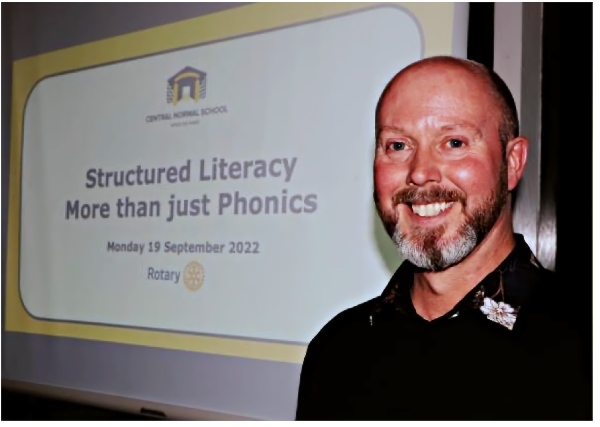
 On the 19th of September, we were treated to an informative talk from Regan Orr, Principal/Tumuaki of Central Normal School and current President of the Manawatu Principals’ Association.
Regan outlined the differences between the Structured Literacy and Whole Language approaches to teaching literacy, namely:
Structured Literacy Approach
Structured Literacy Approach
- Explicit and deliberate teaching of
- phonological awareness
- A strong focus on letter/sound
- relationships
- focus on decoding and encoding
- It is cumulative and systematic
- Works for ALL children, especially those who have learning difficulties
Whole Language Approach
- Guess and check
- Reliant on the experiences of the child
- Open to interpretation
- Only works for those children who are readers
Why Structured Literacy?
There has been significant research and evidence to support the Structured Literacy approach. It is aligned to brain/cognitive development of how the brain learns. It has been extensively researched by numerous academics worldwide, including our own Professor James Chapman of Massey University.
There has been significant research and evidence to support the Structured Literacy approach. It is aligned to brain/cognitive development of how the brain learns. It has been extensively researched by numerous academics worldwide, including our own Professor James Chapman of Massey University.
Structured Literacy focuses on phonological awareness (letters, sounds, rhyme, syllables, onset and rhyme, blending, sliding sounds together, handwriting, orthographic mapping [bonding sounds to letters/letter-sound relationships]). The Whole Language approach focuses on basic sight words (committing words to memory rather than sounding them out).
Regan gave an example sentence from a reading book written for early readers: ' I am in the playhouse’. The accompanying photo showed children playing outside on the lawn in a makeshift ‘tent’ made from chairs, a picnic table and sheets. Without prior knowledge, a child may find it difficult to guess the missing word. They may guess ‘tent’, which would be incorrect. Alternatively, the reading books designed for the Structured Literacy approach use words made up of letters that the child has been learning as part of the stage they are at, e.g. Stage 1 letters are m,s,f,a,p,t,c,i. So all of the words in the Stage 1 books are made up of these letters, e.g. the characters in the books are Sam, Pip and Tim. They have a cat who is fat. Stage 2 letters are b,h,n,o,d,g,l,v, and the accompanying books introduce the words dog, hog, van, hat, not, and bad.
There are also books written in Te Reo Māori for use in bilingual classes and schools.
The Decline in Literacy Rates
New Zealand’s literacy rates have been declining. Regan highlighted some of the issues teachers and schools face, which include:
- Absenteeism
- Oral language (or lack of)
- Disruption - some families are viewing
- school as a choice, and therefore don’t
- regularly attend if at all
- Screens/devices
- Societal changes
What Have We Seen?
There has been a marked increase in literacy rates in schools implementing the Structured Literacy approach. Between 2018 and 2021, the success rate for Māori students has increased from 47% to 71%, and for New Zealand European students from 57% to 70%.
There has been a marked increase in literacy rates in schools implementing the Structured Literacy approach. Between 2018 and 2021, the success rate for Māori students has increased from 47% to 71%, and for New Zealand European students from 57% to 70%.